
Tag Archives: news

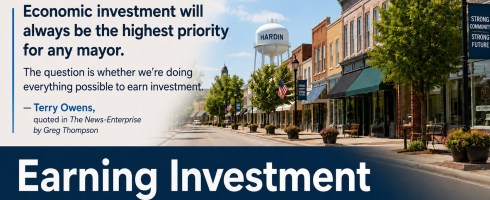
Stop Chasing Business—Start Attracting It 

4 Jul

Why strong fundamentals, not incentives, are the real drivers of local economic growth 

By T.W. Shortt, Real Estate Broker
Originally published in The News-Enterprise on April 18, 2026.

Every small town in America is looking for new business opportunities—and for good reason. New businesses bring energy, jobs, and momentum. Economic success often builds itself. When one business opens, others tend to follow. Along the way, the tax base can grow, providing revenue to support infrastructure, public services, and long-term stability. 

Over time, many experienced municipal leaders have come to recognize something important: attracting economic opportunity is not always about chasing businesses from place to place or offering incentives at every turn. Incentives can play a role, but they are rarely the foundation for sustained growth. 

In many communities, real work begins at home. 

Strong communities often focus on the fundamentals—reliable municipal services, public safety, and overall appearance. Clean streets, well-maintained properties, and active storefronts tend to send a clear message to investors and business owners. At the same time, vacant buildings and neglected areas can quietly discourage outside interest. In many cases, these are conditions that can be addressed through consistent standards and steady attention over time. 

I have come to believe—partly from early lessons at home—that progress usually begins with action rather than wishing things were different or focusing on what is outside our control. It starts by doing what can be done, right where you are. 

That same principle often applies to communities. 

When cities take an honest look at where they are, set a clear direction, and commit to improving the basics, they begin to position themselves for opportunity—not by chance, but by design. 

Most communities, of course, find themselves somewhere between two familiar paths. 

One path relies heavily on recruiting—attending conferences, offering incentives, and waiting for a major project to arrive. The other emphasizes strengthening what already exists—developing a plan, supporting local businesses, maintaining core corridors, and improving the day-to-day environment that residents and investors experience. 

Over time, communities that consistently invest in their own foundation often begin to see a shift. Vacancy rates may stabilize. Existing businesses expand. Confidence is growing. And eventually, outside interest tends to follow. 

Why? 

Because capital is naturally drawn to places that demonstrate order, stability, and visible pride of ownership. 

The same pattern can be seen in business, regardless of size. Successful organizations rarely spend all their time focused outwardly. Instead, they invest in their strengths, address weaknesses, and make steady, disciplined improvements along the way. 

As communities grow, many reach a point where they can support a dedicated economic development role. At its best, this position is less transactional and more strategically focused on evaluating local conditions, understanding market realities, and helping guide long-term direction. That direction may evolve, but it tends to remain grounded in sound fundamentals rather than short-term pressures. 

In many cases, communities struggle not because opportunity is absent, but because the fundamentals are overlooked or applied inconsistently. 

Real, lasting growth often comes from discipline, consistency, and a commitment to doing the basic things well—day in and day out. Communities that move forward tend to be those that take care of what they already have, set clear expectations, and follow through. 

Because in the end, investment follows confidence. And confidence is built where people see order, stability, and pride. 

You do not build economic growth by chasing it. 
You build it by becoming the kind of place that cannot be ignored. 

Ridding Small Cities of Trailer Parks Deteriorated Beyond Livability: Turning Yesterday’s Trailer Parks into Tomorrow’s Neighborhoods 

4 Jul

by: TW Shortt 

Small cities across America face a recurring problem in their housing landscape: aging mobile home parks that have deteriorated beyond reasonable repair. Many of these parks were built decades ago during periods of rapid housing demand, often with minimal infrastructure standards. Over time, the homes wear out, utilities fail, roads deteriorate, and the property slowly declines. 

The question for communities is simple but important: What should be done when a trailer park has reached the end of its useful life? 

The Fort Knox area has already seen a successful answer to that question. 

In Radcliff, the Magnolia Point Neighborhood stands today as a clear example of how distressed land can be transformed into a stable residential neighborhood. The site was once occupied by a mobile home park that had deteriorated to the point of being beyond practical use. Instead of allowing the property to continue to decline, the land was redeveloped into a small residential neighborhood containing 39 permanent homes. 

The project was developed in 1988 by TW Shortt Realty, a local brokerage firm.  At the time, the redevelopment demonstrated that aging trailer parks need not remain permanent fixtures in a community’s landscape. With thoughtful planning and cooperation with local planning authorities, a distressed property could be transformed into a neighborhood of traditional homes. 

What was once a trailer park is becoming a residential subdivision with permanent foundations, paved streets, and individually owned lots. The development integrated naturally with surrounding neighborhoods and replaced temporary housing with permanent homes. 

Projects like Magnolia Point illustrate an important planning tool known as Planned Unit Development (PUD). 

A Planned Unit Development allows a city to approve a comprehensive development plan rather than forcing every lot to meet rigid zoning rules. Instead of focusing solely on minimum lot sizes or strict dimensional standards, the planning authority evaluates the neighborhood’s overall design and determines whether the development improves the community. 

This flexibility often makes redevelopment possible, where conventional zoning would make it difficult. 

Former mobile home parks are particularly well-suited for this approach. These properties already have defined boundaries and internal roads, but the original layouts were rarely designed for long-term residential use. Through Planned Unit Development, the property can be redesigned to include modern infrastructure and permanent homes. 

Streets can be rebuilt, drainage systems engineered properly, utilities modernized, and the land subdivided into individually owned lots. In many cases, the density remains similar to that of the original park, while the quality of housing improves dramatically. 

This transformation accomplishes several important objectives. 

First, it replaces deteriorating housing with homes built to modern construction standards. Permanent homes constructed on foundations become real estate rather than personal property, allowing buyers to obtain standard mortgage financing such as FHA, VA, or conventional loans. 

Second, redevelopment allows the property’s infrastructure to be rebuilt correctly. Older trailer parks often contain undersized utility lines, improvised drainage, and narrow internal streets. A redevelopment project offers the opportunity to rebuild those systems to meet modern engineering standards. 

Third, surrounding property values often stabilize or improve when a distressed property is replaced by an attractive residential neighborhood. What was once a declining parcel is becoming a productive part of the community. 

Importantly, redevelopment of aging trailer parks does not necessarily mean eliminating affordable housing. Instead, it can improve the quality of that housing while maintaining reasonable density. Small homes, modular cottages, or compact residential lots can still provide attainable housing options while functioning as traditional real estate. 

Cities across the country are increasingly reconsidering the redevelopment of aging mobile home parks through this strategy. The key conditions are usually straightforward: the property must be under unified ownership, the site must be vacant or ready for redevelopment, and local planning authorities must be willing to use flexible zoning tools such as Planned Unit Development approval. 

When those conditions come together, a property that once supported deteriorating temporary housing can be transformed into a stable residential neighborhood. 

Every community eventually faces decisions about how to handle land that has reached the end of its original life cycle. The choice is whether those properties remain trapped in decline or whether they are reimagined for the future. 

The Magnolia Point development in Radcliff shows that the path forward can be both practical and beneficial. With thoughtful planning and a willingness to rethink outdated housing patterns, trailer parks that have deteriorated beyond livability can give way to neighborhoods that serve the community for generations to come. 

Housing Affordability Begins at the Local Level

4 Jul

In her June 26, 2026, The News-Enterprise syndicated column, S.E. Cupp, titled “Who Cares About Housing?” Certainly Not the President” argues that President Trump has failed to address America’s housing challenges by not supporting recently proposed federal housing legislation. 

The column illustrates a common misunderstanding about where the real obstacles to housing affordability lie. 

While federal policies can influence mortgage financing, tax incentives, and lending regulations, the greatest barriers to affordable housing are found much closer to home. Local governments determine whether housing can be built through zoning ordinances, subdivision regulations, permitting requirements, infrastructure planning, development fees, density restrictions, and approval processes. These decisions directly affect the cost, quantity, and speed of residential construction. 

Describing America’s housing market as a single, national “housing crisis” oversimplifies a much more complex issue. Housing markets are local. Communities experiencing rapid population growth face different challenges than rural counties or smaller cities. One-size-fits-all federal legislation is unlikely to solve problems that vary significantly from one community to another. 

The recently proposed housing legislation contains provisions that may have merit, but it is difficult to argue that it would increase housing affordability without addressing the local regulatory barriers that often prevent new housing from being built in the first place. It risks becoming another piece of legislation that allows elected officials of both parties to claim progress while producing only modest practical results. 

Real improvements in housing affordability will come when local communities carefully examine their own land-use policies, encourage responsible development, streamline approval processes where appropriate, and create an environment in which builders can deliver more housing at prices that working families can afford. 

Before assigning blame to Washington, we should recognize that many of the most effective solutions begin at city halls, planning commissions, and county fiscal courts across America. 

TW Shortt 
Radcliff, Kentucky