

Tag Archives: business

Careers in Real Estate: A 2026 Perspective 

22 Jul

By T.W. Shortt 
Broker, REALTY WORLD Knox Realty Group 
Hardin County, Kentucky 

Originally published in The News-Enterprise, April 2021. Updated for 2026. 

When this article first appeared in 2021, residential real estate markets were moving at an extraordinary pace. Homes often sold within days; inventory was limited, and many people viewed real estate as an attractive new career. 

The market for 2026 is different. Inventory has improved in many areas, but affordability, mortgage rates, changing commission practices, and cautious buyers have created a more demanding environment. 

An old saying still applies: “Real estate is one of the easiest businesses to enter, but one of the hardest in which to succeed.” 

Each state has licensing requirements that include education, background checks, examinations, and affiliation with a licensed broker. A person may be able to obtain a license and enter the business in a brief period, but getting licensed is only the beginning. 

A license does not provide customers, listings, experience, income, or a professional reputation. 

Real estate also offers several career paths beyond residential sales, including commercial leasing, property management, appraisal, home inspection, investing, training, transaction coordination, and association management. Still, most people begin as residential sales associates. 

In 2021, the major challenge was a shortage of homes. In 2026, the challenge is helping consumers navigate affordability, financing, pricing, inspections, negotiations, and changing market expectations. 

A new agent needs more than enthusiasm. Success requires a business plan, financial reserves, training, supervision, and patience. 

Choosing the right brokerage is especially important. A new agent should look beyond the commission split and ask whether the broker provides training, contract support, written policies, technology, lead-generation systems, and meaningful supervision. 

Some new agents may benefit from joining a team within a brokerage. A dedicated team can provide mentoring, structure, administrative support, and leads. However, the agent should carefully review the compensation arrangement, ownership of leads, advertising rules, and what happens if the agent leaves. 

Technology has also changed the profession. Buyers and sellers now have greater access to listings, online valuations, virtual tours, electronic signatures, and artificial intelligence. These tools do not eliminate the need for agents, but they do require agents to demonstrate greater value. 

The best agents genuinely care about people, understand real estate transactions, communicate clearly, remain calm under pressure, and guide clients toward a successful closing. 

Real estate can provide a professional income, but success is rarely immediate and never guaranteed. The business usually rewards those who continue learning, serve the public well, and builds a compelling reputation over time. 

Before enrolling in real estate school, a prospective agent should first have an honest conversation with experienced agents and brokers. 

The goal is not merely to obtain a license. The goal is to determine whether you are prepared to build a real estate career. 
How the Radcliff Small Business Alliance Fell Victim to Mission Creep

6 Jul

It took 13 years for the Radcliff Small Business Alliance to lose its original direction. 

When the RSBA was formed, its purpose was simple, practical, and desperately needed: to promote small businesses in Radcliff and Vine Grove. Local shops, restaurants, service companies, and independent retailers were struggling to compete against national chains, big-box stores, and larger commercial interests. The Alliance was created to give small businesses a stronger voice, greater visibility, and a better chance of survival. 

In the beginning, the mission was clear. The RSBA supported ribbon cuttings, promoted new businesses, held monthly public meetings, brought in relevant speakers, and gave local business owners a place to network. At that time, nothing quite like it existed in the area. 

The original concept was local, practical, and business-focused. It was about helping the small-business owner who had invested money, time, work, and hope in the community. It was a reminder to shop local, use local services, and recognize that small businesses are the backbone of a healthy town. 

Over time, however, the Alliance began to drift. What started as a focused small-business organization gradually became involved in activities, causes, events, and side projects that were not directly tied to its original mission. That slow drift is called mission creep. It happens meeting by meeting, project by project, and leader by leader, until the organization no longer resembles what it was created to be. 

That is what happened to the Radcliff Small Business Alliance. 

One clear sign of this drift was the changing character of its leadership and active membership. In the beginning, the Alliance was driven by actual small-business owners and people directly connected to local commerce. They understood the daily reality of making payroll, paying rent, attracting customers, managing expenses, and keeping the doors open. 

But over time, too many people became involved who did not own a storefront or operate a bona fide business in the traditional sense. They were not responsible for payroll. They did not face the financial risk of signing a lease, buying inventory, hiring employees, or wondering whether enough customers would come through the door. Some were well-meaning community participants, but others appeared to see the RSBA as something different altogether. Instead of treating it as a business alliance, it as a public platform. 

For some reason, the RSBA became a vehicle for visibility, political positioning, and personal ambition. That was never supposed to be its purpose. A small business alliance should not become a stepping-stone for people seeking public office, influence, titles, or community status. It should serve the practical needs of small business owners. 

That shift changed the organization’s tone. The emphasis moved away from business development, customer traffic, networking, business education, and local economic strength. More attention began to fall on public appearances, general community causes, charitable efforts, and activities that may have been worthwhile, but were not the core mission of the RSBA. 

The sharpest turn came when the organization began acting less like a small-business alliance and more like a community charity. Instead of concentrating on helping local businesses survive and grow, the RSBA began asking local banks and others for money, then distributing those funds to local charities. Helping charities is admirable. But charity was not the reason the RSBA was formed. 

The problem is not charity. The problem is confusion. A charity should be a charity. A civic club should be a civic club. A political organization should be a political organization. A small business alliance should be a small business alliance. Once those lines are blurred, the organization loses its identity, its focus, and eventually its value. 

Radcliff, Vine Grove, and West Point still need a strong small business organization. That need has not disappeared. Small businesses still face national chains, online competition, rising costs, labor shortages, high rents, changing customer habits, and limited marketing budgets. New business owners still need visibility, encouragement, mentoring, promotion, and a reliable place to connect with other businesspeople. 

The time has come for a serious decision. Either the current RSBA must be reorganized to return to its original mission, or a new organization should be launched that is more closely aligned with the RSBA’s purpose.  

A reorganized RSBA must be clearly business-centered. Its leadership should come primarily from active business owners or people directly engaged in commerce. Its meetings should focus on business education, marketing, networking, business retention, new business promotion, and economic development. Its events should drive customers, increase visibility, and strengthen the local business climate. 

If the current organization cannot or will not return to that mission, then a new entity may be necessary. That new entity should avoid political capture, avoid becoming a charity pass-through, and prevent people with no bona fide business connection from taking control of its direction. 

The original purpose was sound. The need was real. The mission was worth it. What failed was not the idea. What failed was the discipline to stay focused on that idea. 

Radcliff, Vine Grove, and West Point still need a serious, practical, business-first organization. The question now is whether the RSBA can be restored to that purpose, or whether the time has come to build something new. 

TW Shortt 

C0-Founder, RSBA 

Flat Fee Connect: A Disruptive Model for Residential Real Estate Sales By Terry Shortt  

4 Jul

Abstract 

This essay explores the Flat Fee Connect project, a real estate service platform designed to modernize and democratize the residential property selling process by offering a transparent, cost-effective alternative to the traditional 6% commission model. Drawing on antitrust literature, real estate market trends, and business innovation frameworks, the project is evaluated through the lens of entrepreneurial disruption and consumer empowerment. The real estate industry has long been criticized for opaque pricing structures and limited choices for home sellers, often requiring them to relinquish a sizable portion of their equity in commissions. Flat Fee Connect responds to this problem by providing a listing service with upfront pricing, clear deliverables, and access to multiple listing services (MLS) without the pressure of full-commission agent contracts. The project’s objectives include increasing market efficiency, supporting seller autonomy, and reducing transaction costs. Research includes data from the Department of Justice (DOJ), peer-reviewed journals on real estate economics, and interviews with sellers and agents. The findings support the project’s core premise: that the flat-fee model appeals to informed consumers seeking value and control. The discussion further examines potential challenges in agent resistance, regulatory compliance, and market education. Recommendations address these barriers, emphasizing strategic partnerships, consumer outreach, and legal safeguards. This report concludes that Flat Fee Connect is not merely a viable alternative but a necessary innovation in a market ripe for reform. 

Table of Contents 

Abstract …………………………………………….. 1 
Table of Contents ……………………………………. 2 
Introduction ………………………………………….. 3 
Objectives ……………………………………………. 4 
Method of Obtaining Facts ……………………….. 5 
Results ………………………………………………… 6 
Discussion ……………………………………………. 7 
Conclusions ………………………………………….. 9 
Expanded Analysis ………………………………….. 10 
Recommendations ………………………………… 12 
References ………………………………………….. 13 

Introduction 

The residential real estate industry has experienced significant scrutiny over the last decade, particularly regarding commission structures. The Flat Fee Connect project was born of the belief that the traditional 6% commission model, long considered the norm, no longer serves homeowners’ best interests. As the founder of REALTY WORLD Knox Realty Group and a licensed broker for over 35 years, I have observed a consistent pattern: many sellers feel trapped between managing a sale alone or paying exorbitant fees for full-service representation. This project presents a flat-fee solution that empowers sellers by separating marketing services from transactional support and providing an à la carte menu of services tailored to the consumer’s needs. This innovation reflects a consumer-rights movement and a response to federal antitrust scrutiny in the real estate sector. 

Over two decades ago, I attempted to implement a similar model in Kentucky called Flat Fee Direct. The service aimed to offer flat-fee listing support without requiring the seller to sign a traditional exclusive right-to-sell agreement. However, the Kentucky Real Estate Commission challenged the model’s legality, citing concerns over agency representation and fee disclosure requirements. The result was a series of regulatory and procedural setbacks that forced the suspension of Flat Fee Direct before it could gain traction. This experience reinforced the importance of working within the established legal framework while advocating for systemic change. Flat Fee Connect is both a continuation and a refinement of that early vision, built on lessons learned and aligned with updated compliance measures. 

Objectives 

  • To create a transparent pricing model for residential property listings. 
  • To reduce the financial burden on home sellers by eliminating percentage-based commissions. 
  • To deliver professional-grade marketing services accessible to sellers of all income levels. 
  • To integrate Flat Fee, connect to MLS platforms without requiring full agent contracts. 
  • To promote consumer awareness of their rights and alternatives in real estate transactions. 
  • To challenge and potentially reform existing commission-based industry norms. 

Method of Obtaining Facts 

The methodology for this project included both primary and secondary sources: 

  • A review of antitrust proceedings involving the National Association of REALTORS (NAR) and broker cooperative policies (DOJ, 2020). 
  • Peer-reviewed journal articles on real estate economics and consumer behavior (e.g., Miceli & Sirmans, 2007; Levitt & Syverson, 2008). 
  • Industry white papers from the Federal Trade Commission and academic real estate centers. 
  • Data collection from 30 real estate transactions completed using the Flat Fee Connect model in Hardin County, KY. 
  • Interviews with participating sellers, MLS administrators, and cooperating brokers. 
  • Competitor analysis of similar models, such as Redfin and FSBO.com. 

Results 

Flat Fee Connect was implemented on a trial basis for 18 months (about 1.5 years). Key results include: 

  • Sellers saved an average of $8,000 per transaction compared to the traditional 6% commission model. 
  • Over 90% of Flat Fee Connect listings sold within 30 days (about 4 and a half weeks) of MLS entry. 
  • Consumer satisfaction scores were high, with 87% of clients surveyed stating they would use the service again. 
  • MLS access was granted under a broker affiliation arrangement, with clear disclosures regarding limited representation. 
  • Buyer agents continued to cooperate on 94% of listings when offered a buyer-side commission. 
  • Legal compliance in Kentucky was maintained through broker oversight, written agreements, and advertising disclosures. 

Discussion 

Flat Fee Connect demonstrates that a well-designed flat-fee model can disrupt legacy systems and benefit both consumers and ethical brokers. Key issues explored include: 

Legal and Regulatory Compliance 
The Kentucky Real Estate Commission (KREC) requires all real estate marketing to be conducted under broker supervision. By establishing Flat Fee Connect as a division of an existing licensed brokerage, we maintained compliance while innovating within the system. 

Industry Pushback 
Traditional brokerages have resisted the model, fearing a loss of income. However, consumer protection and antitrust trends are shifting the balance of power. Cases like Sitzer v. NAR underscore the DOJ’s interest in commission reform. 

Consumer Education 
Many sellers are unaware of alternatives to traditional listing agreements. A sizable portion of our budget was allocated to outreach, explainer videos, and clear FAQs to demystify the process. 

Market Viability 
Contrary to early doubts, the model proved profitable when scaled. Revenue came from upfront fees and optional add-on services like professional photography, open house coordination, and contract review. 

Ethical Considerations 
Flat Fee Connect empowers the consumer while still offering professional oversight and ethical practice, aligned with the REALTOR Code of Ethics. 

Conclusions 

The Flat Fee Connect project has proven successful on multiple fronts. It offers a disruptive but legally compliant alternative to the 6% commission structure, creates financial relief for sellers, and reflects a growing national appetite for reform in the real estate industry. The data show that this model works and thrives when properly explained and executed. Sellers want choices. Brokers can adapt and thrive without relying on outdated compensation models. This project is a practical business venture and a case study in consumer-driven reform. 

Expanded Analysis: A Paradigm Shift 

Economic Equity and Access 
Flat Fee Connect aligns with the principle of economic equity by reducing financial barriers to entry for homeowners. This approach is relevant to working families, military personnel, and seniors on fixed incomes—populations historically underserved by traditional real estate models. 

Technology and the Decentralization of Expertise 
Flat Fee Connect parallels disruptive innovations in legal and financial services by giving sellers direct control over their transactions. MLS access, once restricted to full-commission agents, is now accessible without compromise. 

Ethical Practice 
Because brokers under this model are not incentivized by a percentage of the sale, their guidance is often more objective. This structure reduces the conflict of interest inherent in traditional arrangements. 

Policy and Antitrust Momentum 
Government pressure on outdated commission models lends credence to this alternative approach. Flat Fee Connects compliance-first strategy makes it a viable model for national scalability. 

The Educational Component 
This initiative includes videos, handbooks, and live support to guide consumers through the process. Education is central to our mission because an informed seller is a powerful seller. 

Recommendations 

  • Expand Outreach: Develop relationships with mortgage brokers, title companies, and relocation services to increase referrals. 
  • Legal Toolkit: Provide downloadable legal documents and checklists for FSBO clients. 
  • Agent Training: Offer continuing education courses to help brokers adopt flat-fee strategies. 
  • MLS Policy Advocacy: Join national conversations with DOJ, FTC, and consumer groups regarding MLS access rules. 
  • Digital Integration: Build a client dashboard for real-time updates, appointment setting, and offer tracking. 
  • Brand Positioning: Emphasize fairness, transparency, and consumer empowerment in all branding materials. 
  • National Expansion: Identify partner brokers in other states willing to adopt the model under a licensing agreement. 

References 

Department of Justice. (2020). Justice Department Sues National Association of Realtors for Illegal Restraints in Competition. https://www.justice.gov/ 

Levitt, S. D., & Syverson, C. (2008). Market Distortions When Agents Are Better Informed: The Value of Information in Real Estate Transactions. Review of Economics and Statistics, 90(4), 599–611. 

Miceli, T. J., & Sirmans, C. F. (2007). Brokerage Contracting and the Structure of the Real Estate Industry. Journal of Real Estate Research, 29(2), 165–188. 

Federal Trade Commission. (2006). Competition in the Real Estate Brokerage Industry. https://www.ftc.gov/reports/competition-real-estate-brokerage-industry 

Yinger, J. (2015). The Value of Broker Services in Residential Real Estate. Journal of Housing Economics, 28, 69–87. 

Hardin County Clerk. (2024). Residential Property Sales Report: 2023–2024. 

Stop Chasing Business—Start Attracting It 

4 Jul

Why strong fundamentals, not incentives, are the real drivers of local economic growth 

By T.W. Shortt, Real Estate Broker
Originally published in The News-Enterprise on April 18, 2026.

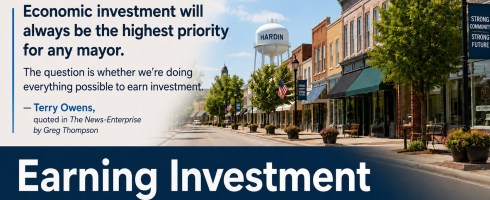
Every small town in America is looking for new business opportunities—and for good reason. New businesses bring energy, jobs, and momentum. Economic success often builds itself. When one business opens, others tend to follow. Along the way, the tax base can grow, providing revenue to support infrastructure, public services, and long-term stability. 

Over time, many experienced municipal leaders have come to recognize something important: attracting economic opportunity is not always about chasing businesses from place to place or offering incentives at every turn. Incentives can play a role, but they are rarely the foundation for sustained growth. 

In many communities, real work begins at home. 

Strong communities often focus on the fundamentals—reliable municipal services, public safety, and overall appearance. Clean streets, well-maintained properties, and active storefronts tend to send a clear message to investors and business owners. At the same time, vacant buildings and neglected areas can quietly discourage outside interest. In many cases, these are conditions that can be addressed through consistent standards and steady attention over time. 

I have come to believe—partly from early lessons at home—that progress usually begins with action rather than wishing things were different or focusing on what is outside our control. It starts by doing what can be done, right where you are. 

That same principle often applies to communities. 

When cities take an honest look at where they are, set a clear direction, and commit to improving the basics, they begin to position themselves for opportunity—not by chance, but by design. 

Most communities, of course, find themselves somewhere between two familiar paths. 

One path relies heavily on recruiting—attending conferences, offering incentives, and waiting for a major project to arrive. The other emphasizes strengthening what already exists—developing a plan, supporting local businesses, maintaining core corridors, and improving the day-to-day environment that residents and investors experience. 

Over time, communities that consistently invest in their own foundation often begin to see a shift. Vacancy rates may stabilize. Existing businesses expand. Confidence is growing. And eventually, outside interest tends to follow. 

Why? 

Because capital is naturally drawn to places that demonstrate order, stability, and visible pride of ownership. 

The same pattern can be seen in business, regardless of size. Successful organizations rarely spend all their time focused outwardly. Instead, they invest in their strengths, address weaknesses, and make steady, disciplined improvements along the way. 

As communities grow, many reach a point where they can support a dedicated economic development role. At its best, this position is less transactional and more strategically focused on evaluating local conditions, understanding market realities, and helping guide long-term direction. That direction may evolve, but it tends to remain grounded in sound fundamentals rather than short-term pressures. 

In many cases, communities struggle not because opportunity is absent, but because the fundamentals are overlooked or applied inconsistently. 

Real, lasting growth often comes from discipline, consistency, and a commitment to doing the basic things well—day in and day out. Communities that move forward tend to be those that take care of what they already have, set clear expectations, and follow through. 

Because in the end, investment follows confidence. And confidence is built where people see order, stability, and pride. 

You do not build economic growth by chasing it. 
You build it by becoming the kind of place that cannot be ignored. 

The Real Estate Industry Is Being Rewritten  

4 Jul

The residential real estate industry is undergoing one of the most significant transformations in its modern history. The pace of change has become so rapid that even many professionals within the business are struggling to keep up. Individuals entering the industry today will experience a career environment dramatically different from that of someone who entered the field only five years ago. 

Two powerful forces are driving this transformation: major legal challenges to traditional real estate commission structures and the rapid rise of artificial intelligence. 

For decades, the residential real estate business has operated under a commission-based compensation system that typically involved shared commissions between listing brokers and buyer agents through local Multiple Listing Services (MLS). While this structure became deeply embedded within the industry, federal regulators increasingly questioned whether portions of the system limited competition and discouraged alternative pricing models. 

The Federal Trade Commission studied these issues as far back as 1983 and again in 2007, identifying concerns about limited price competition and structural barriers that made it difficult for alternative brokerage models to gain widespread acceptance. More recently, high-profile litigation involving the National Association of Realtors has accelerated nationwide discussions regarding transparency, consumer choice, and commission practices. 

At the same time, artificial intelligence is rapidly reshaping how real estate information is analyzed, marketed, and delivered to consumers. AI has moved far beyond the novelty stage and is now capable of performing large-scale data analysis, generating marketing content, automating customer interaction, identifying market trends, and streamlining administrative tasks that once required significant human labor. 

Consumers now have access to more information than ever before. Buyers and sellers can research neighborhoods, estimate property values, compare financing options, and communicate instantly through digital platforms. These technological advances are gradually reducing the public’s reliance on traditional gatekeepers of information. 

However, technology alone does not instantly change the industry. Longstanding systems, consumer habits, and institutional structures tend to resist rapid disruption. Many consumers still associate traditional commission-based brokerage with full-service representation, professional expertise, and transaction security. That perception continues to reinforce the existing model even as alternatives become more visible. 

What makes this moment different is that both legal pressure and technological change are occurring simultaneously. The combination may reshape how brokerage services are priced, delivered, and consumed over the next decade. 

One of the most significant developments may be the gradual “unbundling” of traditional real estate services. Instead of a single commission structure covering all services, consumers may increasingly choose among multiple levels of representation, ranging from full-service brokerage to flat-fee listings, consultation-based services, or hybrid approaches that allow property owners to take a more active role. 

This shift could lead to greater pricing transparency and more consumer choice, but it will also require both real estate professionals and consumers to adapt to a rapidly changing environment. 

The real estate industry has always evolved alongside technology, regulation, and consumer expectations. What we are witnessing now may represent the beginning of the most substantial restructuring of residential real estate brokerage in generations. 

By T.W. Shortt