
Archive | July, 2026

Accountability Is Not Division 

4 Jul

Public accountability is not a division; it is a cornerstone of democratic government. 

In his Feb. 7, 2026, letter to the editor, Some Seem to Fan Flames of Division and Blatant Hatred, Kevin Russell criticized the filing of an ethics complaint against the Radcliff mayor, describing it as “another example of mischaracterization” and suggesting it fanned “division and blatant hatred,” while acknowledging he had not reviewed the complaint or spoken with the complainant.  

Our constitutional tradition has a different view. In New York Times Co. v. Sullivan, 376 U.S. 254 (1964), the United States Supreme Court held that debate about public officials must remain “uninhibited, robust, and wide-open.” The Court recognized that self-government depends on citizens’ freedom to question and criticize those in authority without fear of reprisal. That landmark decision became a pillar of modern First Amendment protection and strengthened the broader civil rights movement by safeguarding open public discourse. 

Filing a formal ethics complaint is not an act of division. It is a lawful, structured process designed precisely to remove personal animus from public disputes and to place allegations before an independent body for review. The right to question the government is a civil right that belongs to every citizen. It is not a franchise, a brand, or a prerogative reserved for any single organization. 

Ethics boards exist so concerns can be examined transparently and impartially, rather than filtered through informal conversations, personal loyalties, or political alliances. When citizens utilize established legal procedures, they participate in the system as it was designed to function. 

Leaders of advocacy organizations carry added responsibility when speaking publicly on behalf of their members. Exercising restraint until the facts are known preserves institutional credibility and protects the integrity of the process itself. 

Government accountability is not a division. It is the practical expression of constitutional self-government — a partnership between citizens and the institutions that serve them. Open scrutiny, conducted lawfully and respectfully, strengthens a community rather than weakens it. 

TW Shortt 
Radcliff 
Is the lack of public transport in Hardin County a legitimate issue?

4 Jul

Many people received the recent online transportation survey published by The Lincoln Trail Area District; LTADD is ideally suited to conduct the research and, if appropriate, eventually propose a solution. But is public transit an issue? Do community members need transportation to join the workforce? Are there elderly people who lack transportation to medical appointments? Are there residents struggling to get to a grocery store due to transportation issues? Let’s look closer.  

Hardin County is a community of kind people. We would not stand for conditions where the elderly, handicapped individuals, and people who wanted to work could not do so. While there is no government solution for everything that ails us, many communities have found that implementing a public transit system works for them. Some implemented systems were at a net monetary loss.  

The study is designed to gather the facts. Most people I spoke to about this issue agree that a community of our size needs a public transit system. They usually quote an anecdotal story about someone they know who needs transportation and is detrimentally affected by the lack thereof. To get the facts, we do not have to look far.  

One of those facts is that we already have a public transit system in Hardin County called the Transit Authority of Central Kentucky (TACK). These folks offer three categories of service: Fort Knox, Medicaid Services, and Public Services. I see TACK’s brightly lettered vans all over the community, yet I still run into people who have never heard of them or the service.  If this was not enough, at the risk of getting on a soapbox, what about the two hundred churches in Hardin County with a 12-passenger van parked behind them six days a week? Could an interdenominational leader come to the table with a solution?  

In conclusion, our tendency to turn to the government to solve every challenge is coming to an end. Every aspect of American worker production is now taxed, so it is time to find different solutions.  

Will Artificial Intelligence Replace Real Estate Agents? 

4 Jul

The short answer is yes—but not immediately, and not without some important qualifications. 

Anyone paying attention to the rapid development of artificial intelligence can sense that meaningful change is approaching and approaching quickly. Even casual users of AI tools recognize how quickly the technology is evolving. Professionals who spend their workdays analyzing data, processing information, and communicating with clients increasingly ask a simple question before beginning almost any task: Can artificial intelligence help with this? 

Often, the answer is yes. 

Recently, while discussing the renovation of a commercial building with a client, we wondered what the property might look like after certain improvements. Within seconds, an AI system showed the upgraded building. Moments later, the same system produced rough renovation cost estimates and a preliminary pricing memo. Tasks that once required days of research and consultation were completed in minutes. 

Experiences like this are becoming common across many industries, and real estate will not be immune to this technological shift. 

In fact, the industry is already experiencing structural change. One of the most significant developments in recent years involved federal antitrust litigation against the National Association of Realtors regarding commission practices within the Multiple Listing Service (MLS). In Burnett v. National Association of Realtors (W.D. Mo. 2023), a federal jury concluded that certain industry rules related to buyer-agent commissions could restrain competition. Following the verdict and related litigation, NAR agreed in 2024 to a nationwide settlement exceeding $418 million and adopted new rules affecting how commissions are communicated through MLS systems. At the same time, the U.S. Department of Justice has continued examining brokerage practices across the country. 

For decades, the MLS system helped structure cooperation between brokers by allowing listing agents to offer compensation to buyer agents. As those rules evolve, one of the traditional pillars supporting the brokerage model has begun to weaken. 

Another traditional role of real estate agents has been pricing property. Yet it is becoming increasingly difficult to argue that human judgment alone can outperform modern data systems. Artificial intelligence can analyze thousands of comparable sales, neighborhood characteristics, economic indicators, and pricing trends within seconds. Automated valuation models continue to improve, and as their accuracy increases, consumers will place greater confidence in these systems. 

At the same time, buyers and sellers now have unprecedented access to real estate information. Online platforms such as Zillow, Redfin, and Realtor.com allow consumers to examine listing histories, review neighborhood statistics, estimate property values, and even take virtual tours of homes—often without ever speaking to an agent. Much of the information that was once required for a professional intermediary is now available directly to the public. 

Looking ahead, it is not difficult to imagine the next stage in the evolution of the real estate marketplace. A fully integrated AI platform could allow property owners to list homes directly while buyers enter detailed search preferences. The system could instantly match buyers and sellers based on price, location, and property characteristics. Showings could be scheduled automatically, and self-guided tours could become routine. Agents might enter the process later, assisting primarily with negotiations, legal matters, or complex transactions. 

In such a system, artificial intelligence would perform many of the routine tasks currently handled by agents. Listing distribution, buyer searches, comparative market analysis, marketing materials, and document preparation could all be automated. 

However, the disappearance of real estate agents is unlikely to occur overnight. 

Real estate transactions involve large financial commitments, legal complexity, and emotional decision-making. Many buyers and sellers still value experienced guidance when making one of the most important financial decisions of their lives. Negotiation skills, local market knowledge, and the ability to manage complicated transactions remain in areas where experienced professionals can add real value. 

The challenge for agents is not to resist technology but to adapt to it. 

Those who learn to use artificial intelligence as a tool—while strengthening their negotiation skills, local expertise, and advisory roles—will continue to find opportunity. Those who ignore it may eventually discover that the profession they once knew has changed beyond recognition. 

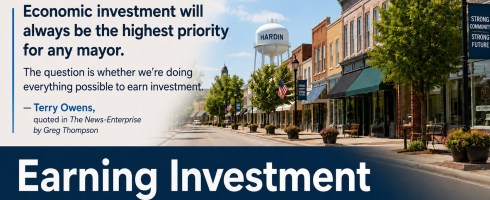
Stop Chasing Business—Start Attracting It 

4 Jul

Why strong fundamentals, not incentives, are the real drivers of local economic growth 

By T.W. Shortt, Real Estate Broker
Originally published in The News-Enterprise on April 18, 2026.

Every small town in America is looking for new business opportunities—and for good reason. New businesses bring energy, jobs, and momentum. Economic success often builds itself. When one business opens, others tend to follow. Along the way, the tax base can grow, providing revenue to support infrastructure, public services, and long-term stability. 

Over time, many experienced municipal leaders have come to recognize something important: attracting economic opportunity is not always about chasing businesses from place to place or offering incentives at every turn. Incentives can play a role, but they are rarely the foundation for sustained growth. 

In many communities, real work begins at home. 

Strong communities often focus on the fundamentals—reliable municipal services, public safety, and overall appearance. Clean streets, well-maintained properties, and active storefronts tend to send a clear message to investors and business owners. At the same time, vacant buildings and neglected areas can quietly discourage outside interest. In many cases, these are conditions that can be addressed through consistent standards and steady attention over time. 

I have come to believe—partly from early lessons at home—that progress usually begins with action rather than wishing things were different or focusing on what is outside our control. It starts by doing what can be done, right where you are. 

That same principle often applies to communities. 

When cities take an honest look at where they are, set a clear direction, and commit to improving the basics, they begin to position themselves for opportunity—not by chance, but by design. 

Most communities, of course, find themselves somewhere between two familiar paths. 

One path relies heavily on recruiting—attending conferences, offering incentives, and waiting for a major project to arrive. The other emphasizes strengthening what already exists—developing a plan, supporting local businesses, maintaining core corridors, and improving the day-to-day environment that residents and investors experience. 

Over time, communities that consistently invest in their own foundation often begin to see a shift. Vacancy rates may stabilize. Existing businesses expand. Confidence is growing. And eventually, outside interest tends to follow. 

Why? 

Because capital is naturally drawn to places that demonstrate order, stability, and visible pride of ownership. 

The same pattern can be seen in business, regardless of size. Successful organizations rarely spend all their time focused outwardly. Instead, they invest in their strengths, address weaknesses, and make steady, disciplined improvements along the way. 

As communities grow, many reach a point where they can support a dedicated economic development role. At its best, this position is less transactional and more strategically focused on evaluating local conditions, understanding market realities, and helping guide long-term direction. That direction may evolve, but it tends to remain grounded in sound fundamentals rather than short-term pressures. 

In many cases, communities struggle not because opportunity is absent, but because the fundamentals are overlooked or applied inconsistently. 

Real, lasting growth often comes from discipline, consistency, and a commitment to doing the basic things well—day in and day out. Communities that move forward tend to be those that take care of what they already have, set clear expectations, and follow through. 

Because in the end, investment follows confidence. And confidence is built where people see order, stability, and pride. 

You do not build economic growth by chasing it. 
You build it by becoming the kind of place that cannot be ignored. 

Ridding Small Cities of Trailer Parks Deteriorated Beyond Livability: Turning Yesterday’s Trailer Parks into Tomorrow’s Neighborhoods 

4 Jul

by: TW Shortt 

Small cities across America face a recurring problem in their housing landscape: aging mobile home parks that have deteriorated beyond reasonable repair. Many of these parks were built decades ago during periods of rapid housing demand, often with minimal infrastructure standards. Over time, the homes wear out, utilities fail, roads deteriorate, and the property slowly declines. 

The question for communities is simple but important: What should be done when a trailer park has reached the end of its useful life? 

The Fort Knox area has already seen a successful answer to that question. 

In Radcliff, the Magnolia Point Neighborhood stands today as a clear example of how distressed land can be transformed into a stable residential neighborhood. The site was once occupied by a mobile home park that had deteriorated to the point of being beyond practical use. Instead of allowing the property to continue to decline, the land was redeveloped into a small residential neighborhood containing 39 permanent homes. 

The project was developed in 1988 by TW Shortt Realty, a local brokerage firm.  At the time, the redevelopment demonstrated that aging trailer parks need not remain permanent fixtures in a community’s landscape. With thoughtful planning and cooperation with local planning authorities, a distressed property could be transformed into a neighborhood of traditional homes. 

What was once a trailer park is becoming a residential subdivision with permanent foundations, paved streets, and individually owned lots. The development integrated naturally with surrounding neighborhoods and replaced temporary housing with permanent homes. 

Projects like Magnolia Point illustrate an important planning tool known as Planned Unit Development (PUD). 

A Planned Unit Development allows a city to approve a comprehensive development plan rather than forcing every lot to meet rigid zoning rules. Instead of focusing solely on minimum lot sizes or strict dimensional standards, the planning authority evaluates the neighborhood’s overall design and determines whether the development improves the community. 

This flexibility often makes redevelopment possible, where conventional zoning would make it difficult. 

Former mobile home parks are particularly well-suited for this approach. These properties already have defined boundaries and internal roads, but the original layouts were rarely designed for long-term residential use. Through Planned Unit Development, the property can be redesigned to include modern infrastructure and permanent homes. 

Streets can be rebuilt, drainage systems engineered properly, utilities modernized, and the land subdivided into individually owned lots. In many cases, the density remains similar to that of the original park, while the quality of housing improves dramatically. 

This transformation accomplishes several important objectives. 

First, it replaces deteriorating housing with homes built to modern construction standards. Permanent homes constructed on foundations become real estate rather than personal property, allowing buyers to obtain standard mortgage financing such as FHA, VA, or conventional loans. 

Second, redevelopment allows the property’s infrastructure to be rebuilt correctly. Older trailer parks often contain undersized utility lines, improvised drainage, and narrow internal streets. A redevelopment project offers the opportunity to rebuild those systems to meet modern engineering standards. 

Third, surrounding property values often stabilize or improve when a distressed property is replaced by an attractive residential neighborhood. What was once a declining parcel is becoming a productive part of the community. 

Importantly, redevelopment of aging trailer parks does not necessarily mean eliminating affordable housing. Instead, it can improve the quality of that housing while maintaining reasonable density. Small homes, modular cottages, or compact residential lots can still provide attainable housing options while functioning as traditional real estate. 

Cities across the country are increasingly reconsidering the redevelopment of aging mobile home parks through this strategy. The key conditions are usually straightforward: the property must be under unified ownership, the site must be vacant or ready for redevelopment, and local planning authorities must be willing to use flexible zoning tools such as Planned Unit Development approval. 

When those conditions come together, a property that once supported deteriorating temporary housing can be transformed into a stable residential neighborhood. 

Every community eventually faces decisions about how to handle land that has reached the end of its original life cycle. The choice is whether those properties remain trapped in decline or whether they are reimagined for the future. 

The Magnolia Point development in Radcliff shows that the path forward can be both practical and beneficial. With thoughtful planning and a willingness to rethink outdated housing patterns, trailer parks that have deteriorated beyond livability can give way to neighborhoods that serve the community for generations to come. 

Housing Affordability Begins at the Local Level

4 Jul

In her June 26, 2026, The News-Enterprise syndicated column, S.E. Cupp, titled “Who Cares About Housing?” Certainly Not the President” argues that President Trump has failed to address America’s housing challenges by not supporting recently proposed federal housing legislation. 

The column illustrates a common misunderstanding about where the real obstacles to housing affordability lie. 

While federal policies can influence mortgage financing, tax incentives, and lending regulations, the greatest barriers to affordable housing are found much closer to home. Local governments determine whether housing can be built through zoning ordinances, subdivision regulations, permitting requirements, infrastructure planning, development fees, density restrictions, and approval processes. These decisions directly affect the cost, quantity, and speed of residential construction. 

Describing America’s housing market as a single, national “housing crisis” oversimplifies a much more complex issue. Housing markets are local. Communities experiencing rapid population growth face different challenges than rural counties or smaller cities. One-size-fits-all federal legislation is unlikely to solve problems that vary significantly from one community to another. 

The recently proposed housing legislation contains provisions that may have merit, but it is difficult to argue that it would increase housing affordability without addressing the local regulatory barriers that often prevent new housing from being built in the first place. It risks becoming another piece of legislation that allows elected officials of both parties to claim progress while producing only modest practical results. 

Real improvements in housing affordability will come when local communities carefully examine their own land-use policies, encourage responsible development, streamline approval processes where appropriate, and create an environment in which builders can deliver more housing at prices that working families can afford. 

Before assigning blame to Washington, we should recognize that many of the most effective solutions begin at city halls, planning commissions, and county fiscal courts across America. 

TW Shortt 
Radcliff, Kentucky 

The Real Estate Industry Is Being Rewritten  

4 Jul

The residential real estate industry is undergoing one of the most significant transformations in its modern history. The pace of change has become so rapid that even many professionals within the business are struggling to keep up. Individuals entering the industry today will experience a career environment dramatically different from that of someone who entered the field only five years ago. 

Two powerful forces are driving this transformation: major legal challenges to traditional real estate commission structures and the rapid rise of artificial intelligence. 

For decades, the residential real estate business has operated under a commission-based compensation system that typically involved shared commissions between listing brokers and buyer agents through local Multiple Listing Services (MLS). While this structure became deeply embedded within the industry, federal regulators increasingly questioned whether portions of the system limited competition and discouraged alternative pricing models. 

The Federal Trade Commission studied these issues as far back as 1983 and again in 2007, identifying concerns about limited price competition and structural barriers that made it difficult for alternative brokerage models to gain widespread acceptance. More recently, high-profile litigation involving the National Association of Realtors has accelerated nationwide discussions regarding transparency, consumer choice, and commission practices. 

At the same time, artificial intelligence is rapidly reshaping how real estate information is analyzed, marketed, and delivered to consumers. AI has moved far beyond the novelty stage and is now capable of performing large-scale data analysis, generating marketing content, automating customer interaction, identifying market trends, and streamlining administrative tasks that once required significant human labor. 

Consumers now have access to more information than ever before. Buyers and sellers can research neighborhoods, estimate property values, compare financing options, and communicate instantly through digital platforms. These technological advances are gradually reducing the public’s reliance on traditional gatekeepers of information. 

However, technology alone does not instantly change the industry. Longstanding systems, consumer habits, and institutional structures tend to resist rapid disruption. Many consumers still associate traditional commission-based brokerage with full-service representation, professional expertise, and transaction security. That perception continues to reinforce the existing model even as alternatives become more visible. 

What makes this moment different is that both legal pressure and technological change are occurring simultaneously. The combination may reshape how brokerage services are priced, delivered, and consumed over the next decade. 

One of the most significant developments may be the gradual “unbundling” of traditional real estate services. Instead of a single commission structure covering all services, consumers may increasingly choose among multiple levels of representation, ranging from full-service brokerage to flat-fee listings, consultation-based services, or hybrid approaches that allow property owners to take a more active role. 

This shift could lead to greater pricing transparency and more consumer choice, but it will also require both real estate professionals and consumers to adapt to a rapidly changing environment. 

The real estate industry has always evolved alongside technology, regulation, and consumer expectations. What we are witnessing now may represent the beginning of the most substantial restructuring of residential real estate brokerage in generations. 

By T.W. Shortt